Deutsche Fassung: Strafbefehl – Einspruch, Tagessatzhöhe u.a.
Penalty Order in Germany (Strafbefehl): How to Object in Two Weeks
A letter from a German court, a word you have never seen – Strafbefehl – and a sum of money you are supposed to pay. A penalty order in Germany is a criminal conviction without a trial, and it reaches many people who live abroad or do not speak German. Perhaps it concerns a fight, a shoplifting allegation, drugs or a drink-driving stop. It is not right that you should be convicted in a language you do not understand simply because a deadline expired. This article explains what a penalty order means, how the two-week deadline works and which options you have.
What is a penalty order in Germany?
A penalty order is a written conviction issued by a local court at the prosecutor’s request – without a hearing and based only on the case file (§ 407 StPO). It is only possible for less serious offences. If you do not object in time, it becomes final and has the same effect as a court judgment. You are then convicted.
What penalties can a German penalty order impose?
Most penalty orders impose a fine in daily rates. They can also contain a driving ban, the withdrawal of a driving licence or a warning with a reserved fine. If you have a defence lawyer, even a prison sentence of up to one year suspended on probation is possible. The order also names the costs of the proceedings you have to bear.
Drug cases are a typical example – see our article on cocaine and MDMA possession in Germany.
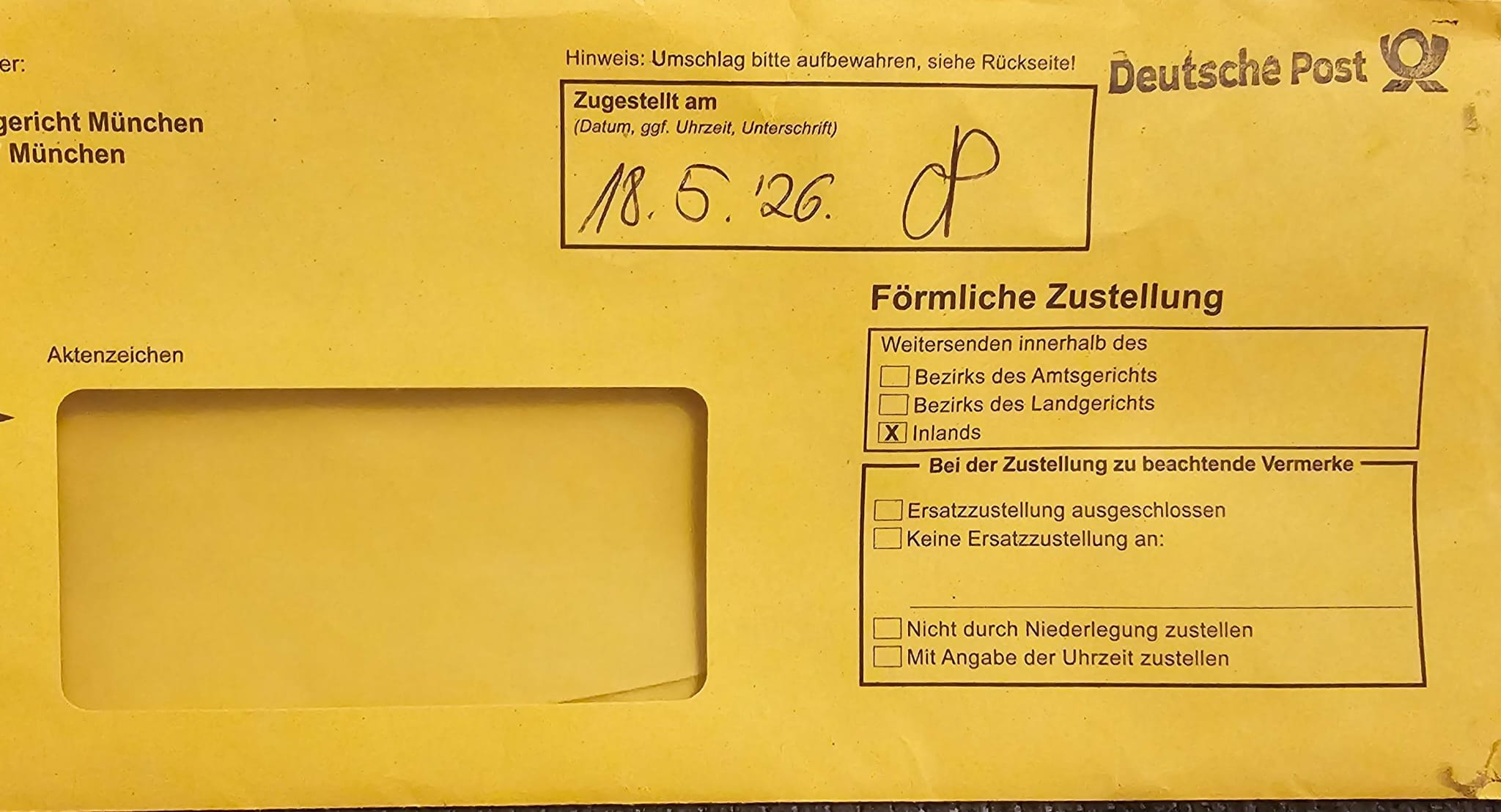
A German penalty order usually arrives in a yellow envelope – from the day of service, the two-week deadline for an objection runs.
How long do you have to object to a penalty order?
Exactly two weeks from service (§ 410 StPO). The date on the yellow envelope counts, not the day you open it. If you named an authorised recipient in Germany, the deadline starts when the order reaches that person – even if you are abroad. Lodge the objection in writing with the local court, and in German.
Which options do you have after receiving a penalty order?
You can accept the order, object to it entirely or limit your objection to specific points, such as the amount of each daily rate. Which option makes sense depends on the evidence in the file and on how the fine was calculated.
| Option | What happens | Typical case |
|---|---|---|
| Accept | Order becomes final after two weeks – you are convicted | Allegation is correct and penalty is appropriate |
| Full objection | Case goes to trial at the local court | Evidence is weak, self-defence, wrong person |
| Limited objection | Only the disputed point is reviewed, often in writing | Income was overestimated, daily rate too high |
Do you have to travel back to Germany if you object?
Often not. After an objection to a penalty order, you may be represented at trial by a defence lawyer with written power of attorney (§ 411 StPO). If neither you nor a lawyer appears, however, the objection is rejected (§ 412 StPO). An objection can be withdrawn later. Be aware, though, that after a trial the penalty can also turn out higher.
How is the fine in a penalty order calculated?
The number of daily rates reflects the seriousness of the offence. Each rate is roughly your monthly net income divided by 30. If the court does not know your income, it estimates it – often too high for students, trainees or people living abroad. A limited objection to the daily rate can reduce the fine considerably. How fines work for a typical offence is explained in our article on the assault charge in Germany.
What if you missed the deadline for an objection?
Then the order is final. If you missed the deadline through no fault of your own, you can apply for reinstatement (§ 44 StPO). The application must be made within one week after the obstacle ceased, together with the objection (§ 45 StPO). Visitors often learn of the order late because it was served on an authorised recipient after a security deposit.

An objection to a German penalty order can usually be handled by your lawyer – without you having to travel back.
Does a penalty order give you a criminal record in Germany?
Every final penalty order is entered in the Federal Central Criminal Register. In the German certificate of conduct, however, a first fine of up to 90 daily rates does not appear. If you cannot pay at once, you can apply to the prosecutor for instalments. Unpaid fines can lead to substitute imprisonment and, within the EU, can generally be enforced in your home country.
How can I help you with a penalty order?
As your defence lawyer, I lodge the objection in time, request access to the file and check whether the allegation and the fine hold up – in English. Penalty orders are based only on the file and are therefore not always correct. The goal, at best, is that the case is dropped or the fine stays below the threshold for your certificate of conduct.
What are the defence lawyer’s final tips?
Defence lawyer’s tip 1: The earlier you involve a lawyer and the earlier they can steer the case, the better the results that can usually be achieved in your investigation or criminal proceedings.
Defence lawyer’s tip 2: Always make use of your right to remain silent! It is one of your most important rights as a suspect. You do not have to incriminate yourself. Do not make any statement about the allegations. Do not attend a police summons for questioning either – contact a lawyer specialising in criminal law first.
Please do not talk to the police – talk to me!
Next steps:
- Contact me at +49 89 228433-55.
- You receive an appointment within 48 hours.
- We discuss your case, including an assessment of your prospects.
- Once instructed, I request access to the case file.
- As soon as the file is available, we plan our strategy together.